 |
|
|
|
|
|
|
|
|
|
 |
|
||||||||
 |
 |
 |
 |
 |
|
||||
 |
 |
 |
 |
 |
|
||||
 |
|
||||||||
 |
|
||||||||
|
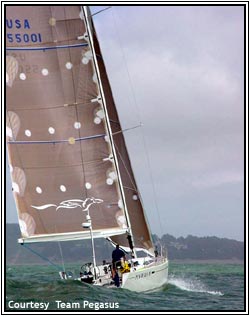
Powered by its enormous rig, Philippe Kahn's new 55-foot cruiser, Pegasus 55, scorches the ocean off San Francisco.
Software magnate Philippe Kahn has become something of a sailing celebrity in the past several years. This West Coast sailor has also grown to attract the envy of hard-core racing sailors across the US because of his active participation at so many levels of the sport. Kahn's personal fleet includes several Megabytes, a couple of Finn dinghies, two Melges 24s, and a 75-foot speedster, which he alternately keeps at either of two properties, one in Santa Cruz, CA, and the other near Honolulu, HI. Last year Kahn won the biennial TransPac Race and months later prevailed over a competitive field of Farr 40s for the rights to represent the US in the Admiral's Cup. But racing isn't Kahn's only on-the-water outlet, and cruising sailors might be interested to know that just about a year ago this racing devotee added a new, high-tech cruising boat to his impressive fleet. Even before its launching Pegasus 55 (it measures 55 feet LOA) was labeled by some pundits as the ultimate performance cruising machine. That claim caught our attention, so we dug around to find out what's behind this sleek new machine. Commissioned from Alan Andrews Yacht Design, the boat was built by Eric Goetz Custom Boats in Bristol, RI. The Goetz company is well known for having produced several America's Cup contenders and a slew of leading edge performance craft, while Andrews is principally recognized as a racing boat designer. Together, these two would seem an unusual combination as the progenitors of a cruising boat, but Kahn, says project manager David Lake, intended for his boat to be an exemplary melding of performance and comfort. According to Lake, this boat had to be versatile. "The client wanted a yacht that could fill a number of roles. His children like sailing and he wanted to bring them along on occasion. He owned a Swan 48 at the time, but there were some things about it that didn't fit for him. He wanted superior performance and he wanted a boat that he could sail easily on his own." The boat's designer, Alan Andrews concurs: "Basically what he was looking for was a boat that he could sail single-handed. One that he could take his family out sailing on and live aboard on for periods of time, as well as a boat that he could race occasionally with transoceanic capability." Andrews says it was a challenge to keep the primary goals in mind, "because the client also wanted a boat that was simple to operate and one with heavy duty, bullet-proof systems. And he also wanted to stress safety in this boat, which is interesting because some of the safety concerns actually translated into some of the styling."
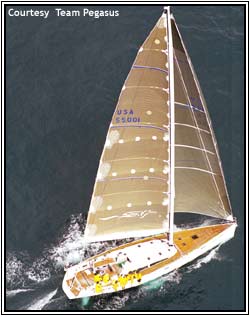
Even viewed from a distance, the clean, unobstructed decks of Pegasus 55 are impressive. Take for example, the simple, clean deck layout on Pegasus 55. At first glance it seems puzzling because you don't see any control lines run on deck. The halyards, sheets, and other controls run beneath the decking in an extensive system of channels and tubes that drain over the side, which is a simple adaptation of applications that have been used aboard large racing boats for years. This, says Andrews, isn't only because Kahn wanted a clean, flush look to the deck, but principally because of the client's concern for safety. Essentially all of the things that might make tripping hazards—sail track, blocks, winches, etc.—aren't there. For instance, the hinges on all nine deck hatches are recessed. What Lake calls the "day-to-day jib" is a self-tacking headsail that runs on a transverse track that is recessed into the foredeck in keeping with this sleek but safe look. Andrews explains that having all-teak decking also stems from this outlook on safety. "Teak decking makes for the best footing available." Though that did add weight, the designer is quick to point out that the planks themselves are actually bonded to the substructure with epoxy. No fasteners have been used in this application, which in itself saves a bit of weight.
The interior aboard Pegasus 55 is another of its true distinctions. Though Kahn wanted to use high-tech solutions to promote safety and performance on board, he was explicit that those requirements not impinge on creature comforts in this boat. The design and building teams went so far as to construct a plywood mimic of the forward cabin so that Kahn could get a better feeling for the actual dimensions. Down below, Pegasus 55 is equipped with hot and cold pressure water dispensed via Hans Grohe fixtures. In the heads and the galley, stainless-steel sinks are surrounded by counters assembled with veneered Corian. And sophisticated, recessed lighting throughout the interior continues the clean, streamlined aesthetic that characterizes the rest of this boat.
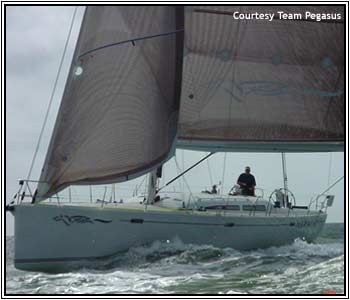
The interior aboard Pegasus 55 is another of its true distinctions. Though Kahn wanted to use high-tech solutions to promote safety and performance on board, he was explicit that those requirements not impinge on creature comforts in this boat. The design and building teams went so far as to construct a plywood mimic of the forward cabin so that Kahn could get a better feeling for the actual dimensions. Down below, Pegasus 55 is equipped with hot and cold pressure water dispensed via Hans Grohe fixtures. In the heads and the galley, stainless-steel sinks are surrounded by counters assembled with veneered Corian. And sophisticated, recessed lighting throughout the interior continues the clean, streamlined aesthetic that characterizes the rest of this boat. Hearing the names Corian and Hans Grohe might make one think heavy, but in its current configuration, this 55-footer displaces just 22,500 pounds. That's pretty remarkable for a cruising boat with a full complement of communications equipment including a mini M system and radar, as well as refrigeration and heating throughout the interior. Consider that a comparably sized boat with similar comforts like an Oyster 55 scales in at about 50,000 pounds. "We put in a watermaker and a cabin heater," explains Lake, "along with a few other items, and that put us about 500 pounds over the designed wait, but it's still very close." Down below, the surfaces are rendered in a combination of mahogany and pear wood, neither of which serve a structural function. All the wood is applied in the form of six millimeter veneers adhered to Nomex or balsa wood panels, which is where the structure resides. Lake relates that the builder used "America's Cup technology" in the hull and deck, meaning that unidirectional carbon fiber joins and covers most of the broad surfaces. "Like all Goetz' custom boats Pegasus 55 was built upside down, and in this case roughly 75 percent of the joiner work was put in the hull while it was inverted. When the hull came off the tooling, it weighed about 1,500 pounds." The deck, the cabin house, and the coaming as well as the cockpit seats were all built in one piece, which according to Lake, scaled in at about 750 pounds. "Having two large pieces that were well engineered in this way saved a lot of weight, and there is minimal secondary bonding, which is very desirable from a standpoint of longevity." Kahn steers his new steed through the froth, protected by substantial freeboard and an ample cockpit coaming.
"We've been sailing the boat in 28 and 30 knots up in the Bay Area with good size waves," relates Lake. "It's surprisingly easy to sail in those conditions. We've also tried to lay the boat flat during ‘tests' and the boat responded pretty well. The boat definitely has trans-ocean capabilities." The design team built in flexibility in case Kahn opted to take the boat, say, to Australia to participate in the Sydney to Hobart Race. "You can change the keel bulb without changing the engineering," says Lake as an example of the kind of forethought that went into Pegasus 55's engineering. But with such an open, seemingly unprotected cockpit, you'd think that the extreme conditions of an open ocean event like that would pose a problem. Not so says Lake. "The transom is open to the sea so there's no way water can build up. The coaming is about nine or 10 inches high off the deck and the boat has decent freeboard as well. In San Francisco where you get a good sea building up we haven't had much water in the cockpit at all. It's a surprisingly dry ride." Lake did allow that a few after market modifications were in the works, like additional handholds in the companionway area. "We're also going to be adding the equipment for a sea dodger, a soft dodger that will fold away, for prolonged upwind stints in nasty weather." Those few changes, says Andrews, are a good measure of success. "Philippe is the kind of guy that has the ability to use the boat and then say let's do this, and this, and this. As the designer, I'm really pleased that the few changes he's wanted are pretty minor." The Production Party Line "Philippe was in touch on a daily basis," says Lake, "often several times a day. We were always sending him e-photos." Though not perfect, Lake says this is actually a pretty good way to go about building a boat. The time intervals between e-mails allow the various parties to study the drawings or images and then compose a response instead of doing so on the fly as one might in a phone conversation. And, says Andrews, because builders and designers are now using the same CAD systems, building a boat in this fashion is increasingly more efficient. "With all of these different suppliers around the world using CAD systems, it ensures that the parts fit once the get to the builder." The other benefit of using e-mail, says Lake is that "It also allowed us to be in contact 24 hours a day if necessary. To get someone on the phone when he's in a meeting or out sailing, isn't practical, but e-mail works great in these situations, particularly with someone as web savvy as Philippe." The other benefit, says Lake, is that with e-mail several different people in various parts of the world can read a missive and respond. "Sometimes getting all of those folks on a conference call can be pretty tough." On paper, Pegasus 55 has the following specs: For additional information on Pegasus 55, contact either: |
|
||||||||
 |
|
||||||||
David Lake Yachting
Projects, LLC
1 Curtis Road, Bristol, RI 02809
v 401.225.0668 f 401.253.1201
davidlake@davidlakeyachtingprojects.com