 |
|
|
|
|
|
|
|
|
|
 |
|
||||||||
 |
 |
 |
 |
 |
|
||||
 |
 |
 |
 |
 |
|
||||
 |
|
||||||||
 |
|
||||||||
|
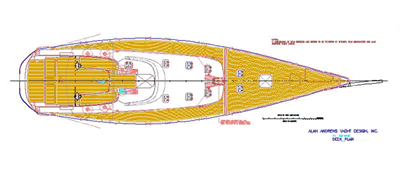
In general, even custom yachts can be described independently of their owners, but in the case of Pegasus 55, designed by Alan Andrews, the owner and the yacht are inextricably entwined. Both are as successful as they are unusual. Philippe Kahn burst upon the yachting scene several years ago and, using the wealth from his computer technology companies, quickly immersed himself in all aspects of the sport. "I love sailing," he said, "and I'm having a blast. My wife says this is indeed my midlife crisis. It is, and it's a perfect mistress." Although Kahn's only sailing experience was sail boarding as a teenager in his native France, not long afterward, he owned three Farr 40s, three Melges 24s and four Mumm 30s. He also kept a Swan 48 in San Francisco as a weekend getaway and for single-handed racing, plus a Finn for Olympic regattas. Just as he'd done with his businesses (he founded Borland, Starfish and now Light Surf), he immersed himself in sailing. But he also knew he needed expert advice and, to that end, brought in talent ranging from Olympic and America's Cup sailor Morgan Larson on the ocean-racing side to Star world champion Mark Reynolds for his one-design efforts. The result is Team Pegasus, and Pegasus 55 is the latest addition to the fleet. Andrews joined Team Pegasus when Kahn acquired the Andrews 70 Cheval. This yacht took line honors in the 1995 TransPac, and Kahn brought in Andrews to upgrade the boat, renamed Pegasus 70, for the 1999 TransPac effort. The new boat had to be light, fast, strong and comfortable. It had to replace the Swan 48 for Kahn and his wife to use as a weekend apartment and for day sailing, but it also had to be competitive in ocean races. And it had to be easily single-handed. For safety's sake, Kahn specified a high range of stability and a clutter-free deck to allow the crew to move around without tripping. Andrews' success at combining the seemingly disparate elements of weekend apartment and single-handed racer was evident the minute I stepped aboard Pegasus 55. Built at Goetz Custom Yachts in Bristol, Rhode Island, under the project management of David Lake, she has exceeded the expectations of everyone on the team. Honey-tone teak decking seems to stretch unbroken in all directions. Even the hardware for the teak hatches is flush-mounted. A Harken traveler, which minds the self-tacking jib, is recessed into the deck to further minimize obstructions. The anchor gear (including a foldout bow roller) hides in a locker, and all the halyards and sail controls run under the deck. The simple cockpit arrangement allows easy passage from the open transom past the twin carbon-fiber steering wheels and centrally mounted carbon-fiber coffee-grinder pedestal to the companionway. Each coaming boasts a pair of Lewmar 60 three-speed primary winches and Lewmar 55 secondaries. All the sail controls exit on each side of the companionway, where two Lewmar 50s and sheet stoppers wait.
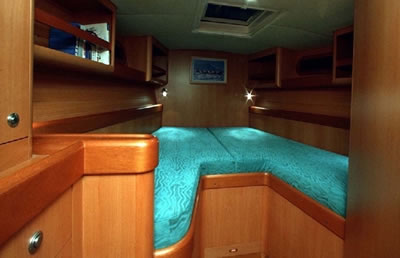
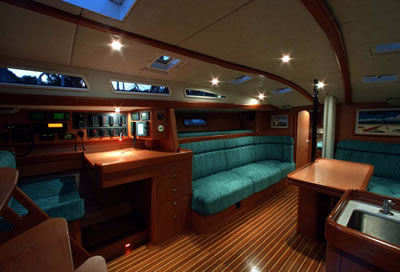
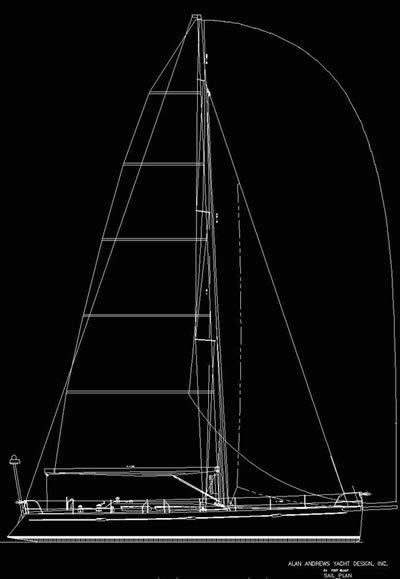
The starboard Lewmar 50 runs electrically, taking the effort out of hoisting sails. The sheet leads are arranged so the electric winch can trim the jib and main during family day sailing. The mainsheet also exits near the primaries, so the coffee grinder can be used to trim the main during races. Southern Spars' shop in Nevada provided the rig, which has no running backstays to complicate shorthanded sailing. Triple spreaders (swept back 20 degrees) provide above-average masthead support for carrying spinnakers or code zero headsails, and a Harken roller furler handles the jib. The storm trysail track, which is aerodynamically faired into the starboard side of the mast, is long enough to allow a slugged trysail to be bagged and stowed on deck, ready to hoist. Below decks, Kahn specified a forward master stateroom, an after cabin for his children and a comfortable living area between. The L-shape settee in the saloon has a double-hinged table, which creates a spacious dining area in conjunction with the port settee. A pilot berth outboard of each settee, complete with lee cloths for rough weather, offers off-watch crew a secure, quiet resting place.
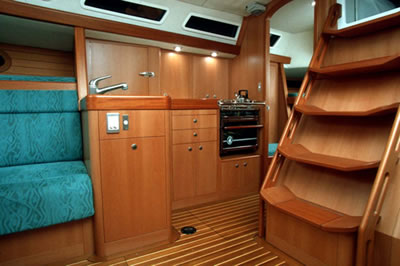
Six opening hatches, plus port and starboard windows in the hull and house, light and ventilate the accommodations, though part of the airy feeling comes from the pale pecan paneling, which was cut from one log and grain-matched by Goetz. The teak-and-holly sole is foam cored, as are the Corian galley counters, to pare off weight. For the galley, Lake devised a sophisticated refrigeration system, which uses gel walls encased in fiberglass to provide exceptional cooling. The Broadwater LPG stove from Australia has two burners plus the broiler and oven needed to make this a weekend condo. Routing the brine tester for the Spectra watermaker to the galley sink makes it easy to check the salinity.
Goetz laminated the hull with high-tech directional fabrics, including an outer layer of woven cloth for long-term low maintenance, over Nomex core. The anchor locker is watertight, as is the sail locker between, giving double protection from collisions. The after bulkhead is watertight under the cockpit. Kahn asked that Pegasus 55 be quieter under power than his Swan 48. Andrews and Lake made the engine room airtight, and then created an intricate baffled ducting system to carry in fresh air while reducing noise. The system, which opens into the cockpit, also has watertight louvers that can be closed down when the yacht is offshore. Soundown Corporation provided the 3-inch lead-and-foam engine room insulation, and the result is that you have to check the tachometer to make sure the 51 hp Yanmar four-cylinder diesel (with Saildrive) is running. As we prepared to leave the dock at St. Francis Yacht Club in San Francisco, Lake said the hardest thing we would do was take off the mainsail cover, which proved true. Aboard were Lake, Zan Drejes (who oversees Kahn's fleet), pro sailor Dee Smith (taking a break from his position as tactician, helmsman and co-navigator on Amer Sports One in the Volvo Ocean Race) and myself. The touch of one finger hoisted the main and spun open the jib, and, still with our hands in our jackets, we were reaching across San Francisco Bay. Time to tack. Spin the wheel, the main snaps over, the jib rolls across, the instruments show a minuscule dip in speed, and we're off on the next tack. As television chef Emeril Lagasse says, "Bam!" As we sailed out under the Golden Gate Bridge, puffs rolled down the hillsides, but they translated to only a brief heel and then pure acceleration. The digital instruments painted 9 1/2 knots at 40 degrees in 12 to 13 knots of wind, making Pegasus 55 no slouch in any league. Spin the wheels to turn downwind, ease the sheets, and Pegasus jumped forward even before the code zero was set, then the acceleration was like going into second gear. The weekend after our sail, Kahn and Drejes finished second boat for boat in the Double-Handed Farallones race just four minutes behind a Wally 67. A month later, Kahn finished first in the single-handed Farallones race in a 53-boat fleet-not bad for a boat just out of the box. As a testament to the teamwork of Andrews, Lake and Goetz, the yacht was built with what Lake guesses to be "around 3,000 e-mails and 300 photographs" but, when Kahn saw his new boat, he made only four minor changes, "and one was a cushion," Lake said with a grin. One thing Andrews says helped make Pegasus 55 so outstanding was that Kahn had a phrase he would use whenever anyone faced a decision: "Never compromise quality." Pegasus 55 sets a new benchmark that is likely to stand for a long time.
Contact: Alan Andrews Yacht Design, (562) 594-9189; alan@andrewsyacht.com; www.andrewsyacht.com.
Specifications: |
|
||||||||
 |
|
||||||||
David Lake Yachting
Projects, LLC
1 Curtis Road, Bristol, RI 02809
v 401.225.0668 f 401.253.1201
davidlake@davidlakeyachtingprojects.com